Dry Rot on Barge Boards & Fascia: What It Means & Fixes
Dry rot on barge boards or fascia is more than a cosmetic issue. Learn what it means for your roof, why “just replacing the board” is tricky, and how repairs really work.
“Can You Just Replace the Board?” – The Call That Inspired This Post
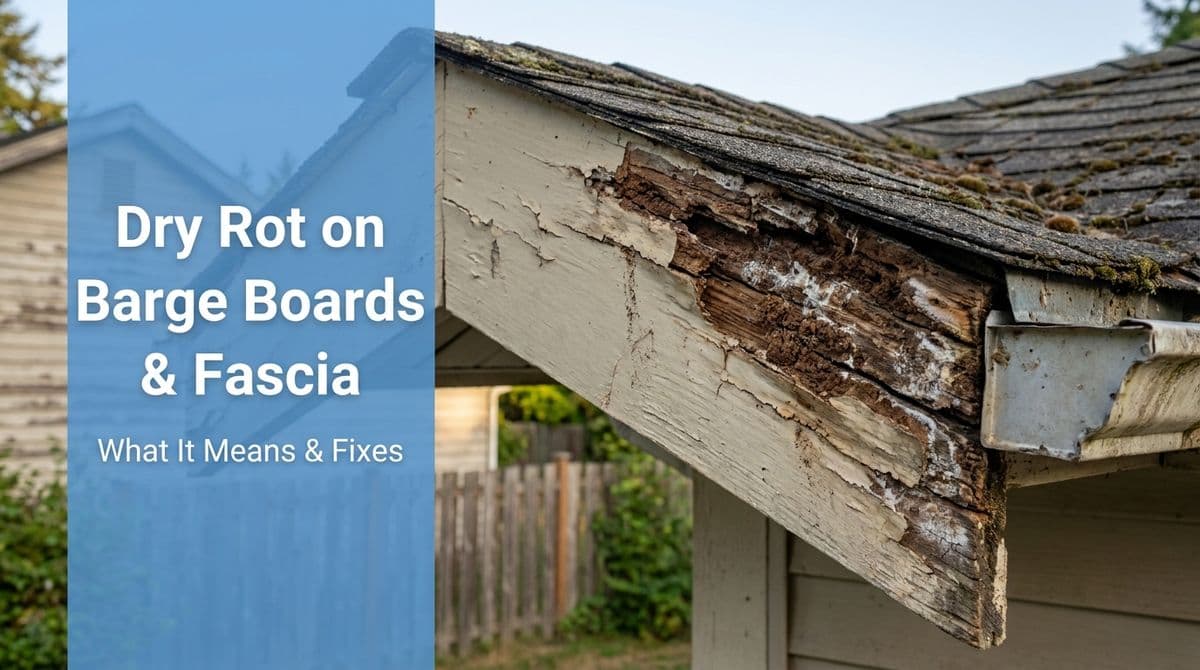
We recently got a call from a homeowner — let’s call her Kelly — who had a long piece of trim on her house with dry rot. It was right where the roof flashing came over the trim that ran up to the peak of the roof.
Kelly’s question was simple: “Can you just replace the board?” As we walked her through the answer, we realized a lot of homeowners have the same questions about barge boards, fascia, dry rot, and how roof trim repairs really work. So we thought we’d break it all down from our perspective as roofing contractors.
What Are Barge Boards and Fascia, Exactly?
When we come out to a home, we often find that people use “trim” as a catch‑all word, and that’s totally understandable. On a typical sloped roof, there are two main exterior trim boards we talk about:
- Fascia – The horizontal board along the eaves, usually where the gutters attach.
- Barge board (also called rake board) – The angled board that runs along the gable end of the roof up to the peak, usually with metal “T” flashing over it.
In Kelly’s case, it wasn’t the gutter board. It was the one that “goes to the peak,” so we knew we were dealing with a barge board. From our standpoint as roofing contractors, that detail really matters, because of how these boards are installed and how we have to repair them.
Why Trim Near Shingles and Flashing Gets Dry Rot
When we see dry rot on barge boards or fascia, it usually comes down to one (or a combination) of these issues:
- Chronic moisture – Water slipping behind flashing or shingles, or splashback from gutters that overflow, can keep the wood damp.
- Failed or aged flashing – T‑metal or drip edge that has rusted, bent, or pulled away stops shedding water properly.
- Old paint or no paint – Bare or peeling wood absorbs water instead of repelling it.
- Roof design details – Tight valleys, short overhangs, or poorly placed seams can concentrate water at the edges.
From our experience, by the time you see dry rot on the outer face of the board, the problem has usually been going on behind the scenes for quite a while. That’s why we rarely treat it as a “just swap the board” situation.
Why You Usually Can’t “Just Replace the Board”
One thing we explained to Kelly – and we say this a lot – is that barge boards and fascia are usually nailed from the top, through the roof deck, shingles, and flashing. That means:
- Shingles overlap the top edge of the board.
- Flashing (T‑metal, drip edge) is nailed through the shingles and into the board.
- All of this is tied together as a system to shed water.
To get a rotten board out, we can’t just pry it off from the side. We have to carefully lift or remove shingles, pull back or remove the flashing, take out the fasteners, and then remove the board. When we put everything back, we’re essentially doing a localized roof repair, not just a carpentry swap.
That’s why, from our standpoint as roofers, we always tell homeowners: we’ll do our best to keep the work area as small as possible, but there will be some disturbance to shingles and flashing. That’s simply how these assemblies are built.
Can Shingles Be Reused, or Do They Need to Be Replaced?
Homeowners often ask us if we’ll need to “put new shingles on the whole side.” Most of the time, no — we’re talking about a section, not the entire roof. Whether we can reuse existing shingles depends on what we see during our inspection:
- On a relatively young roof (under ~15 years) – If the shingles are still flexible and not too brittle, we can usually lift them carefully, remove what we need to, then relay and re-nail them. We may add a few new shingles to blend into the repair area.
- On an older or worn roof – Shingles tend to crack, tear, or disintegrate when we try to lift them. In that case, we plan on replacing that local section with new shingles and making the best color match we can.
We always explain this on site so you know exactly where we expect to reuse shingles and where we’ll need to replace them. Our goal is to balance cost, appearance, and long‑term watertightness.
How Roof Age Affects Whether a Repair Makes Sense
From our perspective as a company, roof age is one of the biggest factors we look at before agreeing to a repair. We’re frank about this with homeowners because it affects both cost and risk:
- Under about 15 years old – If the roof is in otherwise decent shape, a targeted repair on barge boards or fascia usually makes sense. We can tie into the existing system with reasonable confidence.
- Over about 15–20 years old – We get more cautious. When we disturb old shingles and flashing, we’re tying into materials at the end of their lifespan. If a leak develops later at that connection, we’re on the hook for a broader area than we actually worked on.
Sometimes, on an older roof with widespread wear, we’ll gently suggest that your money might be better spent planning a full replacement rather than paying for patch repairs that may not last as long as you’d like.
Material Choices for Replacement Boards
When we do need to replace a barge board or fascia, we talk through material options with you so you know what you’re getting:
- Primed wood (pine, fir) – Common and cost‑effective. Works well if it’s properly primed on all sides and kept painted.
- Cedar – More rot resistant than many softwoods, nice for certain architectural styles, but typically more expensive.
- Composite/PVC trim – Doesn’t rot, great for high‑exposure areas, though it can be pricier and needs correct fastening and expansion gaps.
We match the board size and profile to what you already have so the repair looks intentional, not like a random patch. Whatever you choose, we always recommend priming and painting exposed wood as soon as possible after installation.
DIY vs. Pro: Is This a Weekend Project?
We sometimes hear, “Could I just pull that board off and put on a new one myself?” If the board is nowhere near the roof, maybe. But when we’re talking about barge boards and fascia tied into shingles and flashing, here’s what we want homeowners to consider:
- Safety – Working at height, on ladders or roof slopes, carries real risk.
- Waterproofing details – It’s easy to miss the correct underlayment laps, flashing steps, and nail placement if you don’t do this every day.
- Hidden damage – We routinely find sheathing or rafter tails with rot behind the trim that needs addressing.
If you want a truly watertight, warrantied repair, this is one area where we strongly recommend hiring a professional roofing contractor. A quick fix that looks good from the ground can still leak quietly for years if the flashing details aren’t right.
What to Expect From Our Inspection and Repair Process
When we come out to look at dry rot on barge boards or fascia, we typically follow a simple process:
- Visual inspection from the ground – We look at the overall roof condition, age, and any obvious problem spots.
- On‑roof inspection – We check the affected area up close, test the wood for softness, and see how far the rot extends.
- Check shingles and flashing – We assess whether shingles are reusable and whether the existing T‑metal or drip edge can realistically be saved.
- Discuss options with you – We explain what we’d have to remove, what we can likely reuse, and what we recommend replacing.
- Perform the repair – On the scheduled day, we remove the rotten wood, address any hidden damage, install new boards and flashing, and tie the shingles back in properly.
Throughout the process, we keep you in the loop so there are no surprises about the scope or cost of the work.
Preventing Future Dry Rot on Roof Trim
Once we’ve fixed a rotten barge board or fascia, we always talk through how to avoid a repeat. Here are a few maintenance tips we encourage our customers to follow:
- Keep gutters clean so water doesn’t back up and overflow onto the trim.
- Inspect paint and caulking yearly; if you see peeling paint or open joints, address them before water gets in.
- Look up after storms for sagging gutters, bent flashing, or new stains on the boards.
- Schedule a roof checkup every few years, especially as the roof approaches 15 years of age.
A little attention goes a long way toward extending the life of your trim and your roof system as a whole.
When to Call Us About Dry Rot on Your Barge Boards or Fascia
If you’re seeing soft, crumbling, or discolored trim where your shingles and flashing meet, it’s worth having us take a look. Rot doesn’t fix itself, and catching it early usually keeps the repair smaller and more affordable.
If you’re unsure whether it’s a barge board, fascia, or “just a piece of trim,” that’s okay — that’s what we’re here for. We’ll come out, identify what you’re dealing with, give you honest feedback on your roof’s condition, and recommend a repair approach that makes sense for the age and health of your roof.
We handled Kelly’s situation the same way we handle every call like this: by explaining the realities of how these boards are installed, what we can reuse, and where it’s smarter to replace. If you’re noticing similar dry rot on your home, reach out to us and we’ll help you figure out the right next step for your roof.